|
Powering up the c200
Before
switching on the power, make sure that the preset
R13 is set for maximum resistance and no speakers
are connected to the output of the amplifier. The
Vbe multiplier Q6, must also be thermally coupled
to the main heatsink to prevent thermal runaway.
With
the input shorted to ground, slowly increase the output
of the power transformer to the working voltage of
40-0-40Vac with a variac. This should be done with
an oscilloscope connected to the output of the amplifier.
If
the amplifier is properly assembled, there should
be no oscillations at the output as you gradually
power up the amplifier's transformer. With the supply
rail voltages at +-53.5V, the DC operating points
should read TP1=1.65V; TP2=1.0V; TP3=0.84V; TP4=0.26V
and TP5=0.79V.
Once
this is established, slowly increase the bias of the
output into Class AB to 100mA per output transistor.
A DMM across an emitter resistor (0.39 ohms) should
read 39mV. With the oscilloscope set to 5mV resolution,
you should be able to reproduce Fig 1. |
Small
Power Testing
Switch off the amplifier and connect a 10 watts 8
ohms dummy load to the output. Remove the input short
and connect the signal generator to the amplifier.
Set the oscilloscope to 50mV resolution and slowly
power up the amplifier again. Inject a 10KHz square
wave for a peak to peak reading of 250mV. You should
be able to reproduce Fig 2. There should be no signs
of ringing on the square wave. Rise time should read
2.4us from 10%-90% of 250mVp-p.
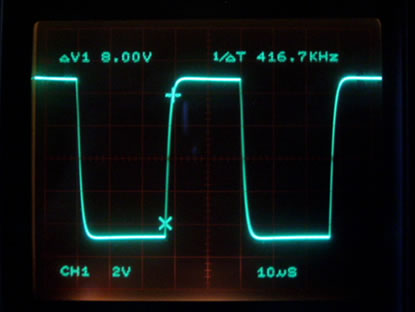
Increase the input signal to reflect 10Vp-p
as seen in Fig 3. Rise time and square wave should
remain unchanged.
Reset the signal generator for 20KHz square wave output.
Repeat the above procedure for an output of 10Vp-p
and you should be able to replicate Fig 4. Note the
absence of overshoot and ringing and fairly wide bandwidth.
1
| 2 | 3 | 4
| 5 | 6
| 7 | 8
Next - THD & Full Power
Testing |